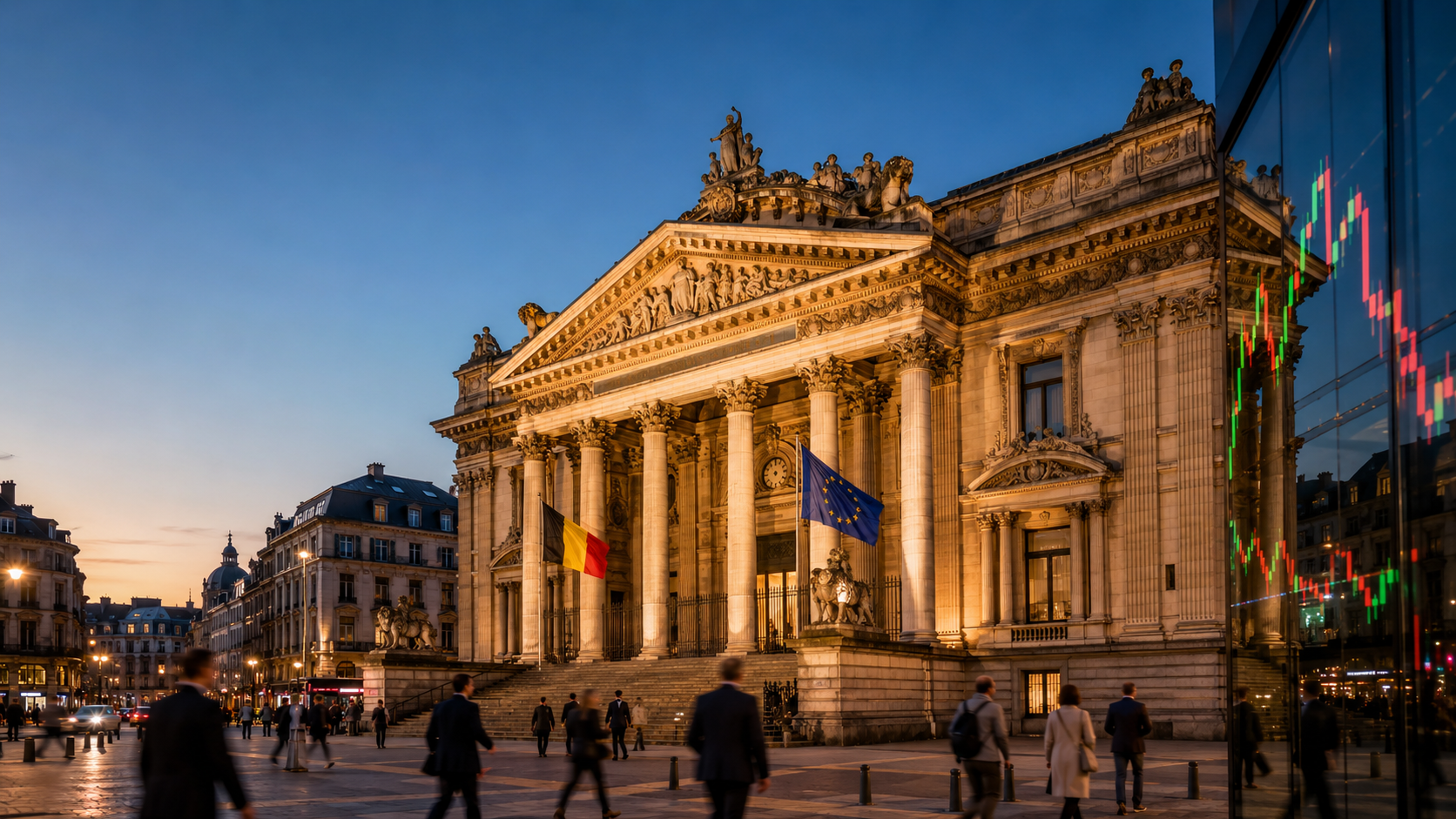
Belgium’s benchmark index has outperformed the broader European market in 2026, supported by healthcare, financials and selected industrial companies. Yet more than half of the BEL 20 is concentrated in just five stocks, making its headline valuation less straightforward than it first appears.
August 5, 2026
The BEL 20 climbed 1.2% to close near 5,776 points on Wednesday, placing Belgium’s benchmark index at a new record level and extending a rally that began in 2025.
The index has advanced approximately 13.7% since the beginning of 2026, based on its closing level of 5,078.43 at the end of last year. Including dividends, the total return is slightly higher.
That performance has exceeded the roughly 10%–11% gain recorded by the STOXX Europe 600 price index over the same period. Belgium has therefore moved from being one of Europe’s frequently overlooked equity markets to one of its stronger performers.
The rally raises an obvious question: after gaining 19% in 2025 and almost 14% this year, is the BEL 20 still attractively valued?
BEL 20 performance at a glance
| Metric | Approximate level |
|---|---|
| BEL 20 close on August 5 | 5,775.95 |
| 2025 closing level | 5,078.43 |
| 2026 price return | Approximately 13.7% |
| 2025 price return | 19.1% |
| One-year change | Approximately 24% |
| Estimated market P/E | Around 17–18 times |
| Estimated underlying dividend yield | Around 2.5%–3.0% |
| Weight of five largest companies | Approximately 56.6% |
The index’s latest level is confirmed by Euronext, while longer-term data show how unusual the recent advance has been. The BEL 20 took almost 18 years to exceed its previous 2007 peak, but it has continued setting records since breaking through that level in 2025.
Strong gains since January
The BEL 20 began 2026 at 5,078.43 points and reached 5,775.95 on August 5. That represents a price increase of approximately 697.5 points, or 13.7%.
An ETF tracking the index reported a year-to-date total return of approximately 14% by late July, illustrating the additional contribution from dividends.
Several factors have supported the Belgian market:
- strong earnings from banks and insurers;
- continued growth from biotechnology and pharmaceutical companies;
- improving investor confidence in European equities;
- declining concerns about Belgian real-estate companies;
- resilient consumer demand;
- and renewed interest in smaller European markets trading below U.S. valuation levels.
The gains have not been evenly distributed. Large index members including UCB, Argenx, KBC and Ageas have had a much greater effect on the benchmark than smaller companies such as Melexis, Aperam, Azelis or Montea.
This is central to understanding the BEL 20: its performance can look broadly Belgian while being driven by a relatively small number of global businesses.
Is the BEL 20 expensive?
Belgian equities currently trade at an estimated aggregate price-to-earnings ratio of approximately 17–18 times trailing earnings.
An August 4 estimate for the wider Belgian stock market placed its P/E at about 17.6 times, near the upper end of its five-year average range of roughly 13.5 to 18.6. This suggests that Belgium is no longer obviously cheap, but it is not yet at an extreme valuation relative to its recent history. World P/E Ratio provides the market estimate.
That headline multiple requires careful interpretation because the index combines very different types of companies:
- banks and insurers trading at relatively modest earnings multiples;
- mature dividend-paying businesses;
- real-estate investment companies valued partly on net asset value;
- and high-growth healthcare companies carrying much higher valuations.
KBC and Ageas make the index look cheaper. Argenx and UCB make it look more expensive. A single aggregate P/E therefore conceals a substantial valuation divide.
At approximately 17–18 times earnings, Belgium is valued broadly in line with the wider European market. The MSCI Europe Index traded at around 18 times trailing earnings and 15 times forward earnings at the end of July.
The BEL 20 does not currently offer a dramatic index-level valuation discount. Its attraction depends more on the quality and earnings prospects of its individual companies.
Dividend yield remains supportive—but uneven
The estimated underlying dividend yield of the BEL 20 is around 2.5% to 3%, although the exact figure changes with share prices, special distributions and dividend announcements.
This is broadly comparable with the European market. The MSCI Europe Index offered a dividend yield of approximately 2.8% at the end of July, while a distributing STOXX Europe 600 ETF showed a trailing yield close to 2.9%.
Dividend income within the BEL 20 is highly concentrated.
KBC and Ageas offer comparatively high shareholder distributions, while real-estate companies such as Aedifica, WDP and Montea also contribute meaningful income. AB InBev has gradually rebuilt its dividend following years of debt reduction.
By contrast, Argenx does not pay a dividend, and UCB’s yield is relatively low because investors value the company primarily for growth.
The five largest companies therefore produce very different income profiles:
| Company | Approximate index weight | Dividend profile |
|---|---|---|
| Argenx | 12.56% | No dividend |
| UCB | 12.36% | Low yield, growth-oriented |
| AB InBev | 11.75% | Moderate and recovering |
| KBC Group | 11.72% | High payout potential |
| Ageas | 8.19% | High and relatively defensive |
| Combined | 56.58% | Mixed |
Investors seeking income should not assume that buying the BEL 20 automatically provides exposure to a uniformly high-dividend portfolio. More than one-quarter of the index is represented by UCB and Argenx, where the investment case is based mainly on pharmaceutical and biotechnology growth.
Five companies dominate the index
Based on the composition published following the March 2026 review, Argenx, UCB, AB InBev, KBC and Ageas together represented approximately 56.6% of the BEL 20.
That means developments affecting only five companies can determine whether the entire Belgian benchmark rises or falls.
Argenx: high growth and high expectations
Argenx is the largest BEL 20 constituent, with a weight of approximately 12.6%.
The company’s investment case is driven by Vyvgart, its treatment for autoimmune diseases, and the possibility of expanding into additional indications. Strong commercial execution can support rapid revenue growth, but the valuation assumes continued clinical and regulatory success.
Argenx increases the BEL 20’s exposure to global biotechnology. It also adds volatility, as trial data, regulatory decisions and competition can produce large share-price movements.
UCB: a growing pharmaceutical heavyweight
UCB accounts for approximately 12.4% of the index.
The Belgian pharmaceutical group has benefited from strong demand for Bimzelx and other growth products. Its business is more diversified and mature than Argenx’s, but its valuation still depends heavily on successful product launches, patent protection and clinical execution.
Together, UCB and Argenx represent almost 25% of the BEL 20. The Belgian benchmark is therefore unusually sensitive to healthcare-sector sentiment.
AB InBev: a global consumer company
AB InBev represents approximately 11.8% of the index.
Although it is listed in Brussels, its earnings are predominantly generated outside Belgium. The brewer provides exposure to global consumer demand, emerging markets, beer pricing and currency movements.
AB InBev has reduced debt considerably since the acquisition of SABMiller, allowing it to increase shareholder returns. It can act as a defensive consumer-staples company, but its substantial emerging-market exposure, dollar-denominated debt and sensitivity to commodity costs introduce cyclical elements.
KBC: a profitable Benelux and Central European bank
KBC has a weight of approximately 11.7%.
The bank-insurer has benefited from resilient net interest income, strong capital generation and exposure to faster-growing Central European economies. It is also one of the BEL 20’s most important dividend contributors.
KBC’s risks include falling interest margins if European rates decline, credit deterioration, regulatory capital requirements and slower economic growth in Belgium or Central Europe.
Ageas: defensive insurance and income
Ageas represents approximately 8.2% of the index.
The insurer offers a combination of European insurance operations and exposure to Asian joint ventures. Its relatively predictable cash generation and dividend policy give the BEL 20 an important defensive component.
Ageas is nevertheless exposed to natural-catastrophe claims, investment-market volatility, interest-rate changes and regulatory requirements.
Comparison with the STOXX Europe 600
The BEL 20 and STOXX Europe 600 have delivered broadly similar returns in 2026, but their structures are very different.
| Characteristic | BEL 20 | STOXX Europe 600 |
|---|---|---|
| Number of companies | 20 | 600 |
| 2026 price performance | Approximately +13.7% | Approximately +10% to +11% |
| Geographic exposure | Belgian listings | 17 European markets |
| Five largest weights | Approximately 56.6% | Significantly lower |
| Main sector exposures | Healthcare, financials, consumer staples | Broadly diversified |
| Technology exposure | Limited | Moderate |
| Estimated dividend yield | Around 2.5%–3.0% | Around 2.8%–3.0% |
| Estimated valuation | Around 17–18 times earnings | Around 15 times forward earnings |
The STOXX Europe 600 covers 600 companies across 17 developed European countries and represents close to 90% of the region’s investable market. STOXX describes it as a broad European benchmark.
The BEL 20 has outperformed during 2026, but the STOXX 600 offers far greater diversification. Weak results from one major European company have only a limited effect on the pan-European index. A sharp decline in Argenx or UCB can have a material impact on the BEL 20.
The European benchmark also provides considerably more exposure to industrial technology, luxury goods, energy, mining, defence and software.
The BEL 20 offers a more concentrated bet on healthcare, financial services and selected defensive companies.
Concentration is the principal index-level risk
The BEL 20 uses free-float-adjusted market capitalization and applies limits intended to prevent a single company from becoming excessively dominant. Even with those limits, concentration remains high.
The five largest constituents represent almost 57% of the index, while UCB and Argenx alone account for nearly one-quarter.
This creates several risks.
Healthcare trial risk
A clinical failure, safety issue or negative regulatory decision involving UCB or Argenx could pull down the entire index even if most Belgian companies were performing well.
Financial-sector exposure
KBC, Ageas, GBL and Sofina give the index significant direct or indirect financial exposure. Belgian real-estate companies also depend on credit conditions and bond yields.
Company-specific shocks
Changes to AB InBev’s volumes, pricing, debt or emerging-market currencies can have an outsized impact on the benchmark.
Limited technology exposure
The index contains Melexis, but Belgium lacks the large technology platforms and semiconductor-equipment companies found in U.S., Dutch and German indices. The BEL 20 can therefore lag during technology-led global rallies.
Weak domestic representation
Several large BEL 20 constituents are global companies whose revenue bears little relationship to the Belgian economy. The index is not a pure investment in Belgian GDP growth.
An investor holding only the BEL 20 may consequently have much less diversification than the number of 20 constituents suggests.
Defensive shares within the BEL 20
The index contains several companies capable of offering resilience during slower economic periods.
Ageas
Insurance premiums and recurring policy income can provide relatively stable cash generation, although investment-market conditions remain important.
AB InBev
Beer demand is generally less economically sensitive than discretionary consumer spending. The company’s global geographic mix also reduces dependence on any single economy.
Elia Group
As a regulated electricity-transmission operator, Elia benefits from relatively predictable long-term infrastructure investment. Its high capital requirements and sensitivity to bond yields are the main counterweights.
Aedifica, WDP and Montea
Belgian listed real estate provides rental income from healthcare properties, logistics buildings and other specialized assets. Lower interest rates can support valuations, while high funding costs or declining property values remain risks.
Lotus Bakeries
The company combines defensive food demand with international brand growth. Its principal challenge is valuation: a high-quality defensive business can still generate weak returns if purchased at an excessive multiple.
Cyclical exposure
Other constituents are more closely linked to the economic cycle.
KBC
Loan growth, credit losses and interest margins depend on monetary and economic conditions.
Umicore
The materials group is exposed to metal prices, electric-vehicle demand, battery-market developments and major capital-allocation decisions.
Syensqo and Solvay
Both chemical companies are sensitive to industrial production, energy prices and global manufacturing demand.
Aperam
The stainless-steel producer depends heavily on European industrial activity, raw-material prices and import competition.
Melexis
The semiconductor group is exposed to the automotive cycle, vehicle production and structural demand for electronic components.
D’Ieteren
Although D’Ieteren contains high-quality assets, parts of its portfolio remain linked to automotive and consumer-market conditions.
This combination gives the BEL 20 some internal balance: healthcare, insurance, utilities and consumer staples can offset weakness in banking, chemicals, metals or semiconductors. Concentration nevertheless means this balance can be overwhelmed by moves in the largest constituents.
Is the Belgian market still attractive?
The BEL 20 remains investable, but it is no longer an obvious bargain after gaining more than 35% across 2025 and the first seven months of 2026.
The bullish case rests on several factors:
- Belgian equities remain less expensive than the U.S. market;
- KBC and Ageas offer attractive capital returns;
- UCB and Argenx provide genuine global healthcare growth;
- AB InBev continues to reduce leverage and rebuild distributions;
- lower European interest rates can support real estate;
- and the index contains several internationally competitive companies.
The cautious case is equally clear:
- the market trades near the upper end of its recent valuation range;
- more than half of the index is concentrated in five companies;
- healthcare valuations depend on successful drug development;
- financial shares may face lower interest margins;
- and the index lacks the breadth of the STOXX Europe 600.
The BEL 20 can therefore remain attractive as a focused allocation to Belgian and internationally active Belgian-listed businesses. It is less convincing as a complete European equity portfolio.
What investors should watch next
The principal factors likely to determine the index’s direction are:
- Vyvgart sales and new indications at Argenx;
- the expansion of UCB’s Bimzelx franchise;
- AB InBev’s organic volume growth and debt reduction;
- KBC’s net interest income and capital distributions;
- Ageas’s cash generation and Asian performance;
- European Central Bank interest-rate decisions;
- commercial-property valuations;
- and the outlook for European industrial production.
Investors should also distinguish between the BEL 20 price index and total-return products. Dividends can materially improve long-term returns, but ETF distributions may not exactly match the underlying index yield because of taxes, fees and reinvestment policies.
The bottom line
The BEL 20’s advance to approximately 5,776 points reflects real fundamental strengths. Belgium has globally competitive pharmaceutical, biotechnology, financial, insurance and consumer companies, and its benchmark has outperformed the wider European market in 2026.
At an estimated 17–18 times earnings, the market is not excessively expensive relative to Europe—but neither is it obviously undervalued after its strong rally. The estimated dividend yield of approximately 2.5%–3% remains supportive, though income is unevenly distributed across the index.
The greatest concern is concentration. Argenx, UCB, AB InBev, KBC and Ageas represent almost 57% of the benchmark. Investors buying the BEL 20 are making significant company-specific bets, particularly on healthcare and financials.
The Belgian market can still offer attractive individual opportunities. At current record levels, however, careful stock selection and diversification beyond Belgium have become more important than simply buying the index.
This article is for informational purposes only and does not constitute investment advice.